Why Visual Motion Can Feel Overwhelming in PPPD
New Research Looks at the Eyes’ Automatic Response
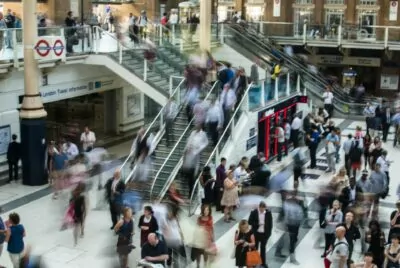
For people with persistent postural-perceptual dizziness (PPPD), a trip to the grocery store, scrolling on a phone, walking through a crowd, or watching fast-moving images on a screen can trigger dizziness, unsteadiness, or disorientation. A new study offers clues about why.
Researchers at University Hospital Zurich investigated how the eyes of people with PPPD respond to visual movement. They found that people with PPPD had more difficulty suppressing an automatic eye movement triggered by motion in their peripheral vision. This difference could help explain why visually complex environments are so challenging for many people with PPPD.
PPPD and “Visual Dependence”
PPPD is a chronic vestibular disorder characterized by dizziness, unsteadiness, or non-spinning vertigo that is often worsened by standing, moving, or exposure to complex visual environments.
One common feature of PPPD is visual dependence—the brain relies too heavily on vision to determine where the body is and whether it is moving. Normally, the brain combines information from the eyes, the vestibular system in the inner ear, and sensors in the muscles and joints to maintain balance and orientation. In PPPD, the balance among these systems may shift, giving visual information too much influence.
That can become a problem in places with a lot of movement to process. Think of walking down a supermarket aisle while other shoppers pass by, watching scenery through a car window, or trying to focus on your phone while people move around you.
Interestingly, many people with PPPD have normal results on standard tests of inner-ear vestibular function. This suggests that the problem may lie less in the sensory organs themselves and more in how the brain processes and combines sensory information.
Testing an Automatic Eye Reflex
The researchers studied 30 people with PPPD and visually induced dizziness and 29 healthy participants. They were particularly interested in something called the ocular following response (OFR).
An OFR is a rapid, automatic eye movement that occurs when a large portion of what we see suddenly begins to move. It happens so quickly—before we consciously process the motion—that it gives researchers a way to study some of the brain’s earliest responses to visual movement.
Participants sat in front of a large screen covered with hundreds of white dots. At different times, either the dots at the center of the screen or those surrounding it began moving left or right. Researchers precisely recorded participants’ eye movements.
In some trials, participants were allowed to follow the moving dots. In others, they were instructed to keep looking straight ahead and resist the natural tendency for their eyes to follow the movement.
The researchers also tested visual dependence by asking participants to judge which way was upright while dots rotated around them.
What Did the Researchers Find?
When movement occurred in the central visual field, both groups produced strong automatic eye-following responses. The most important difference emerged when the center remained still while the surrounding visual field moved.
People with PPPD had stronger involuntary eye movements in response to this peripheral motion. They also had more difficulty suppressing those movements when instructed to keep their eyes fixed on the center.
Healthy participants were generally better able to ignore the surrounding movement and keep their eyes still.
This finding is especially interesting because it resembles situations encountered in everyday life. Imagine trying to look at your phone while walking through a busy airport. You want your eyes to remain focused on the stationary object in front of you, while people and objects are moving throughout your peripheral vision. The brain normally helps suppress unnecessary reflexive eye movements so that your gaze remains stable.
For someone with PPPD, that suppression may not work as effectively.
How Could This Contribute to Dizziness?
When the eyes unintentionally move while a person is trying to focus on something, the image can shift across the retina. This is called retinal slip. Too much retinal slip can interfere with clear, stable vision.
But the researchers suggest there may be another issue as well: a conflict between the automatic urge of the eyes to follow movement in the surrounding field and the conscious effort to keep looking at a particular object.
In a visually busy environment, the brain may therefore be working harder to maintain a stable gaze while simultaneously processing movement all around it. That could contribute to the dizziness, disorientation, and visual discomfort experienced by people with PPPD.
The study also found that people with PPPD were more influenced by a moving visual background when judging which direction was upright. Importantly, greater visual dependence was associated with stronger automatic eye-following responses in the PPPD group. This suggests that these eye movements may be connected to the broader problem of overreliance on visual information for orientation.
What Does This Mean for People With PPPD?
This study does not mean that abnormal eye movements have been proven to cause PPPD. PPPD is a complex condition involving the way the brain processes and integrates visual, vestibular, and other sensory information.
The study was also relatively small, and the participants with PPPD were older on average than the healthy comparison group. The researchers accounted for age statistically, but future studies with age-matched groups will be important. The PPPD participants also developed their condition following a variety of different triggering events, so there may be differences among patients that this study could not identify.
Still, the findings provide another piece of the PPPD puzzle. They suggest that visually induced dizziness may involve changes in very early, automatic visual processing—not simply a conscious reaction to environments that patients have learned to fear or avoid.
That distinction matters. When someone with PPPD says that a grocery store, scrolling screen, traffic, or moving crowd makes them dizzy, their symptoms may reflect measurable differences in how their visual and eye-movement systems respond to motion.
The researchers hope future studies will determine exactly how these altered responses develop and, importantly, whether rehabilitation strategies can help normalize them. That could eventually lead to more targeted approaches for reducing visual dependence and helping people with PPPD navigate visually complex environments more comfortably.
Reviewed by Dr. med. Vergil Mavrodiev
Source
V. V. Mavrodiev, K. P. Weber, C. J. Bockisch, and F. C. Fierz, “ Early Ocular Response to Visual Motion in Patients With Persistent Postural-Perceptual Dizziness.” Annals of the New York Academy of Sciences 1562, no. 1 (2026): e70378. https://doi.org/10.1111/nyas.70378