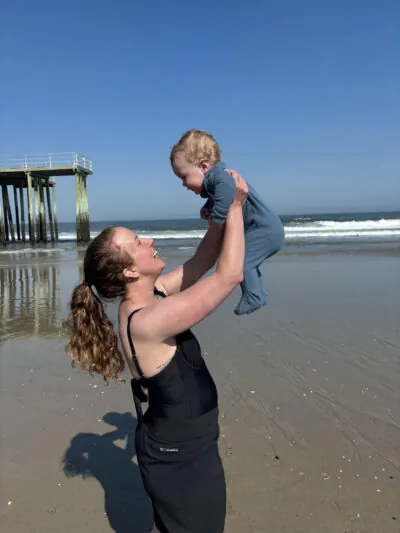
Welcome to a special patient spotlight series in celebration of Dizzy Parents Day, hosted by the Dizzy Moms Club in partnership with VeDA. By sharing these real-life journeys and practical ‘dizzy parenting hacks,’ our goal is to help parents navigating chronic dizziness find their way out of isolation and into a supportive village. Each feature highlights the voice, vulnerability, and inspiring resilience of a parent navigating an invisible vestibular disorder.
Brittany’s Story
What is your specific diagnosis (or type of chronic dizziness), and how old are your child(ren)?
I have Ménière’s disease and am in the process of working with new physicians to rule out vestibular migraine as well. My son is 11 months old
What is a “dizzy parenting hack” or tool you rely on to get through the week?
Accepting help when it’s offered. If help is offered but I’m feeling relatively well, I try not to let the guilt get to me and accept it anyway because that is what helps me avoid a full-blown flare-up. If I wait until I absolutely need it to accept help, it’s much harder to recover.
How do you talk to your children about your dizziness in a way they can understand?
My little guy is too young to have conversations with, but I plan to be very open with him when he’s able to understand.
What has been the most challenging or surprising emotional hurdle of parenting with an invisible illness?
The fear. The relentless fear of the unknown. Will I get worse? Will my child inherit this? The mental load of it is tough.
What is a moment where you felt incredibly proud of yourself as a parent, despite your symptoms?
The first time I drove my son to a store alone! He was about 4 months old, and we drove 2 minutes down the road, but it was the first time I thought to myself, “ok, if I did it once, there’s hope that I can do it again in the future!”
How did finding an ally network or a support group (like the Dizzy Moms Club or VeDA) shift how you view your diagnosis?
I found VeDA a few years ago when I very first got diagnosed. Joining a support group and having people to talk to who truly understood my struggles saved my mental health. I also attended some of the conferences and received invaluable information. I stepped away for a while but when I became a mom and things flared up again, I went back to the VeDA website and was happy to see there are more support groups now than ever- including The Dizzy Moms Club!
Why is an international advocacy day like Dizzy Parents Day so important to you, and what message of encouragement would you send to another parent who is currently suffering alone right now?
Dizzy Parents Day is so important to me because no one should have to go through this alone. It truly does get lighter when you have a community of people who understand what you are going through. The invisible becomes visible. Connections lead to resources you didn’t know existed; treatments you might not have known about otherwise. You don’t have to do this alone.