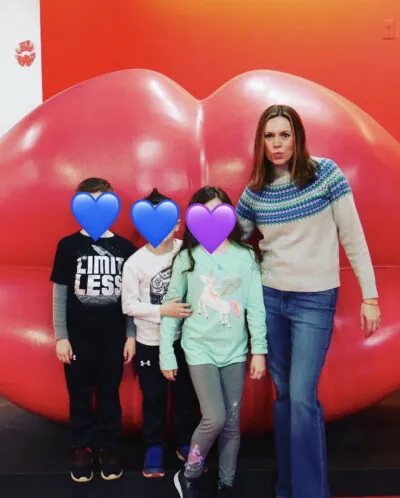
Welcome to a special patient spotlight series in celebration of Dizzy Parents Day, hosted by the Dizzy Moms Club in partnership with VeDA. By sharing these real-life journeys and practical ‘dizzy parenting hacks,’ our goal is to help parents navigating chronic dizziness find their way out of isolation and into a supportive village. Each feature highlights the voice, vulnerability, and inspiring resilience of a parent navigating an invisible vestibular disorder.
Jaclyn’s Story
What is your specific diagnosis (or type of chronic dizziness), and how old are your child(ren)?
Vestibular Migraine, PPPD, POTS, Migraine with Aura (30 years). I have twin boys (age 12) and a daughter (age 15).
What is a “dizzy parenting hack” or tool you rely on to get through the week?
I ask for help when I need it. I don’t feel guilty anymore. I explain to my children that some days I don’t need help, and other days I need you to be more aware of what I might need.
How do you talk to your children about your dizziness in a way they can understand?
When they were younger, it was more challenging when Mom couldn’t drive them places for three years; younger kids don’t understand. But my daughter, who was age 7, would constantly write me letters to keep going and felt empathy since I wasn’t feeling well. As they grew older, they became advocates for me and have such a deep understanding that I keep surviving despite obstacles. It melts my heart when they always say, “You’re the best mom ever.” It turned out those are the moments my children will take to adulthood. In the depths of it, I always felt like I wasn’t giving them the life they deserved.
What has been the most challenging or surprising emotional hurdle of parenting with an invisible illness?
The stigma you get from others to this day still surprises me. No one has to understand, but the lack of understanding made it very uncomfortable for those in my life to give me the support I needed. I didn’t need a solution; I just needed a hug. I needed to know I wasn’t alone. To my surprise, everyone thought I wanted to be alone during this time. I think if people don’t have the answer to help you, they feel uncomfortable when they don’t understand. So, people tend to use avoidance instead of support. Thankfully, now I have a huge support system, but it wasn’t easy to get here.
What is a moment where you felt incredibly proud of yourself as a parent, despite your symptoms?
I am so proud I continued to show up for my three kids despite feeling like I was dying day in and day out for three years. Despite parenting, educating myself, and nonstop doctor appointments that became my life, I kept the love of my kids in my heart, and that love kept moving forward day in and day out.
How did finding an ally network or a support group (like the Dizzy Moms Club or VeDA) shift how you view your diagnosis?
It meant EVERYTHING. As I mentioned above, I never felt so alone in my life. No one understood. As soon as I started advocating for myself and became a member of the groups of people who were just like me, I finally started to realize I did not have to fight this battle all by myself. Someone finally gets me and my life.
Why is an international advocacy day like Dizzy Parents Day so important to you, and what message of encouragement would you send to another parent who is currently suffering alone right now?
As hard as it is to put yourself out there, and in those moments when you fear judgement or telling yourself no one can possibly get me, reframe that into finally feeling hopeful again. People’s stories are the ones that give you hope when you’re feeling all alone. EVERYONE deserves their story to be heard. There are people in this world who will understand and help you feel less alone. One regret I have is not finding those people sooner. Hope is a magical feeling despite your symptoms.