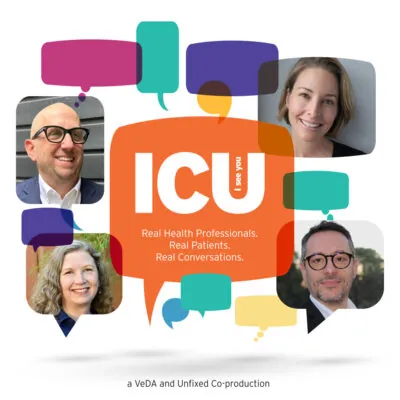
ICU – “I See You” Podcast
Balance Awareness Week
Listen Now
Available wherever you get your podcasts.
In this episode, we’re spotlighting Balance Awareness Week, an annual event hosted by the Vestibular Disorders Association each September. This global campaign raises awareness about the impact of vestibular disorders—conditions that affect balance, dizziness, and spatial orientation—and connects patients, caregivers, and healthcare professionals through education and advocacy. Today we’re going to talk with Paul Morris, VeDA’s Development Director, about how people can get involved in Balance Awareness Week, as well as Christian Chabbert, a French neurophysiologist who engages healthcare professionals across Europe in this event, and is spearheading a global walk for balance.
Guests
Paul Morris has over 30 years experience in nonprofit fundraising, helping a wide spectrum of organizations raise millions of dollars to support their missions. He has led successful development efforts in direct health services at the state and national levels. He’s also helped raise funds for organizations that work in regional theater, architectural preservation, offering chess to low-income students, and more. For Paul, fund development isn’t just about raising money, but building relationships with people in your community so that they feel heard, valued and are excited about supporting their shared mission.
Christian Chabbert is a French neurophysiologist and Research Director at the French National Centre for Scientific Research. He is developing research on balance disorders at the Research Center in Psychology and Neurosciences at the Aix-Marseille University. Since 2015, Dr. Chabbert has directed GDR Vertige, a national research consortium uniting clinicians, scientists, and industry partners to advance the understanding and treatment of vestibular disorders. His expertise in sensory neuroscience and molecular electrophysiology has contributed to over 90 scientific publications and the founding of two biotech companies—Sensorion Pharmaceuticals and Vertidiag—focused on developing therapies for balance-related conditions. Dr. Chabbert also plays a key role in the European PROVIDE network, promoting translational research and innovation in neuro-otology across Europe.
Summary
Balance Awareness Week began over 30 years ago as a VeDA initiative to help people understand what vestibular disorders are and how profoundly they can impact daily life. The term “vestibular” can be intimidating or confusing, but when it’s broken down—inner ear problems, balance issues, vertigo—suddenly people connect the dots:
They may not know the word, but they know the experience.
A critical piece of this campaign is highlighting that vestibular disorders are invisible disabilities. People who live with them usually don’t “look sick,” yet they may be facing debilitating symptoms—constant dizziness, disorientation, fear of falling, and exhaustion from simply trying to stay upright and functional. VeDA’s tagline for the campaign, “Make Vestibular Visible,” captures this mission: to bring these unseen struggles into public awareness, reduce stigma, and foster empathy.
Balance Awareness Week is not just about education; it’s also a major fundraising and community-building effort. The campaign supports VeDA’s work in:
- Educating patients about their conditions
- Connecting patients with knowledgeable healthcare professionals
- Providing peer support
- Supporting research into vestibular disorders
It is VeDA’s largest global campaign, inviting patients, caregivers, clinicians, and researchers to take part in a coordinated, worldwide movement.
Building a Global, Grassroots Movement
One of the most inspiring parts of this episode is hearing how Balance Awareness Week has evolved into a truly global grassroots effort, thanks in large part to leaders like Dr. Christine Chabert.
Based in France, Dr. Chabert is a research director at the French National Center for Scientific Research and leads the Pathophysiology and Therapy of Vestibular Disorders team at the Laboratory of Cognitive Neurosciences at Aix-Marseille University. His background is deeply rooted in sensory neuroscience and molecular electrophysiology, with over 65 scientific publications and experience founding biotech companies focused on therapies for balance-related conditions.
France officially joined Balance Awareness Week in 2022, and from there, the impact has rippled outward across Europe. Dr. Chabert describes how the French community—clinicians, researchers, and patient organizations—has become highly unified, in part due to the creation of GDR Vertige, a national research consortium on vertigo founded ten years ago. This existing network made it possible to mobilize quickly around Balance Awareness Week.
The results have been remarkable. What started as a French initiative has now inspired a pan-European response. In the most recent campaign, 11 European countries participated, including:
- France
- Germany
- United Kingdom
- Ireland
- Italy
- Romania
- The Netherlands
- Switzerland
- Czech Republic
- Greece
- Portugal
Across these countries, practitioners, researchers, and patient groups organized events tailored to their local communities—demonstrating how flexible, creative, and empowering the Balance Awareness Week framework can be.
Personal Motivation and Scientific Passion
Dr. Chabert’s involvement in vestibular research is both professional and personal. He shares that his wife suddenly lost hearing in one ear, likely due to a vascular event, and for several weeks also lost much of her vestibular function on that side. During that time, vertigo was “the worst” part of her experience—more disruptive than the hearing loss itself.
Over time, her vestibular system partially recovered, illustrating the remarkable capacity of vestibular nerve fibers to reconnect with damaged hair cells. But this episode gave Dr. Chabert a deeply personal understanding of how devastating vestibular dysfunction can be.
Even before this, his scientific curiosity had drawn him into the field. During his PhD in Montpellier, he studied the microstructure of the vestibular apparatus, recording electrical activity in vestibular nerve fibers in mice to understand what happens when the inner ear is injured. He describes the vestibular system as a kind of “micromechanical” marvel, constantly at work translating motion into neural signals that allow us to move through the world.
What Balance Awareness Week Looks Like in Practice
Listeners also get a vivid picture of what Balance Awareness Week actually looks like on the ground in Europe. Dr. Chabert outlines a wide range of activities across hospitals, universities, clinics, and communities:
- Public talks and discussion sessions with patients in clinics and hospital settings
- Free balance function testing at university hospitals, giving people hands-on access to evaluation and information
- Articles in health magazines, along with radio segments and TV appearances, to share stories and expert insights with broader audiences
- Lectures at universities by clinicians and researchers on vestibular disorders—their causes, consequences, and progression
- Interdisciplinary seminars in hospitals, where specialists from different fields learn about vestibular care, building bridges across medical disciplines
- Distribution of Balance Awareness Week posters in pharmacies across France, ensuring visibility in cities and small villages alike
These activities don’t just raise awareness; they build networks, connect professionals and patients, and help providers become visible as local resources in their communities.
A Model for Local Action
Hearing about the success across Europe, Kimberly and Cynthia reflect on how this model could inspire more local initiatives in their own communities in Oregon. The episode captures a sense of possibility: that Balance Awareness Week is not a top-down campaign, but a flexible template anyone can adapt—whether you are a patient, clinician, researcher, or advocate.
At its heart, this podcast episode is about connection: connecting terminology to lived experience, connecting isolated patients to supportive communities, and connecting professionals across borders in a shared mission to make vestibular visible.