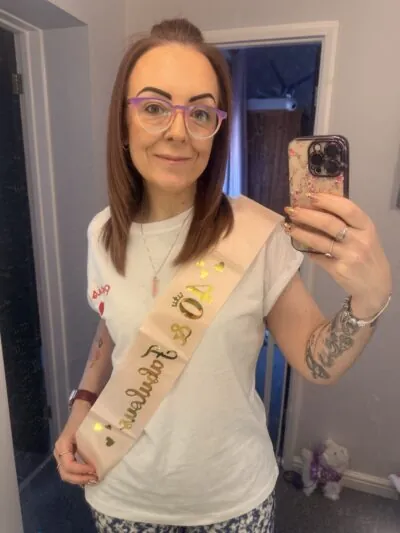
Before vestibular migraine entered my life, I was just a normal busy mum trying to juggle family life, work, school runs and everything in between. I had no idea what the vestibular system even was, let alone that it could completely turn your world upside down.
At the time all of this started, I was working full time to help support my family. I missed my two little girls while I was at work, but they were thriving at nursery and preschool, and we made the most of our evenings and weekends together. I finally felt like I had found a balance between being “mum” and still being me as a person.
When my symptoms first started, I genuinely thought something was seriously wrong with me. I wasn’t just “a bit dizzy.” I felt like I was rocking on a boat, swaying when standing still, disconnected from my surroundings and struggling to trust my own body. I experienced pounding headaches, visual disturbances, dizziness, nausea, brain fog, sensitivity to light and sound, tinnitus, fatigue and overwhelming anxiety that seemed to come from nowhere. Some days it felt like my body and brain were working against me.
One of the hardest parts was how invisible it all was. From the outside I looked fine, but inside I felt scared, exhausted and completely overwhelmed. I was trying to continue being a mum while silently battling symptoms that affected almost every part of daily life. Things other people take for granted — supermarkets, busy environments, scrolling on a phone, even simple family days out — suddenly became incredibly difficult.
Shortly after my diagnosis, I was dismissed from my job, and everything changed.
Not only was I trying to process a life-changing condition, but suddenly I had lost a huge part of my identity too. I have always worked, and after becoming a mum I had slowly started to feel like “Gemma” again — not just somebody’s mum, but me. Losing that so suddenly was something I heavily grieved.
Financially, things became harder too. I had to reduce my youngest daughter’s nursery days because I could no longer afford the extra childcare, which added even more pressure while trying to heal and adjust to this new version of life.
One of the hardest parts of vestibular migraine has been how much it has changed me as a parent.
I grieve the mum I used to be, the one with endless energy, spontaneous days out, silly games and the ability to say “yes” more often. Now my girls see a mum who needs more naps, says “give me one minute” more than she wants to, cancels plans, gets overstimulated and sometimes snaps out of pure exhaustion and overwhelm.
That part breaks me the most.
I apologise to them often and explain that mummy’s head is a little poorly and that I never mean to be impatient. My eldest daughter is incredibly empathetic, and sometimes she cries because she just wants me to get better.
There is a very specific kind of grief that comes with chronic illness and motherhood — trying to adjust to a version of yourself you never expected to become, while still wanting your children to feel loved, safe and happy through it all.
I am still learning how to navigate that new normal.
For a long time, I felt very alone.
I had never heard of vestibular migraine or PPPD before my diagnosis, and neither had most people around me. Trying to explain the symptoms to others was difficult because so many people associate migraine with “just a headache,” when vestibular migraine can affect your entire sense of balance, vision and reality. There were moments where I questioned myself because everything felt so hard to explain.
Over time, I slowly began learning more about vestibular disorders and understanding what was happening to my body. That knowledge changed everything for me. Finding VeDA and the online dizzy community was a huge turning point in my journey. For the first time, I saw people describing the exact same symptoms and emotions I had been experiencing. I realised I wasn’t imagining things, and I wasn’t alone.
One of the biggest sources of support for me has been The Dizzy Moms Club (DMC). Finding other mums navigating vestibular conditions while also trying to raise children made me feel understood in a way I hadn’t experienced before. These were women who truly got it, the guilt, the exhaustion, the overstimulation, the fear, the grief, but also the determination to keep showing up for their families despite it all.
I’ve never really felt like I had much of a “village” around me while raising my children, and chronic illness can be incredibly isolating. But through the vestibular community, and especially through DMC, I found people who reassured me on the hard days, gave me hope and reminded me that recovery isn’t always linear.
Somewhere along the way, I realised I had found my village. My people.
Sharing my experience on Instagram and TikTok started as a way of coping and making sense of what I was going through, but it quickly became something much bigger. I began connecting with people all over the world who were frightened, newly diagnosed and feeling exactly the way I once did. So many people told me they had never heard of vestibular migraine before finding my page, while others simply said, “I finally feel understood.”
That is why awareness matters so much to me.
Managing my symptoms is still an ongoing journey. I’ve learned the importance of listening to my body, pacing myself, reducing stress where possible, understanding my triggers and giving myself grace on difficult days. Some days are still hard, but I’ve also learned that progress doesn’t always look dramatic. Sometimes progress is simply doing something you once thought you couldn’t do again.
I am still currently waiting to see a neurologist, but the waiting list where I live in the UK is at least 12 months long. In the meantime, I’m trying to take things one unsteady day at a time, learning how to navigate the storm while still holding onto hope that things can improve.
One thing that has really stayed with me throughout this journey is the flamingo story. How flamingos can temporarily lose their pink colour during periods of stress, illness or while raising their young, but with time, healing and nourishment, that pink slowly returns.
That story resonates with me deeply.
Vestibular migraine has changed so much about my life and about who I thought I was, but it also reminds me that this version of me is not forever. Even on the hardest days, I hold onto the hope that one day I will find my balance again, and maybe even my pink too.
If I could say one thing to someone at the start of their vestibular journey, it would be this: you are not alone, and you are not “just anxious.” What you are experiencing is real, valid and life-changing. Finding the right treatment and recovery can feel slow and frustrating, but there is hope, support and an entire community of people who truly understand what you are going through.
Becoming a VeDA Ambassador feels incredibly full circle for me. Not long ago, I was desperately searching for answers and reassurance. Now, I hope I can be part of that reassurance for someone else.